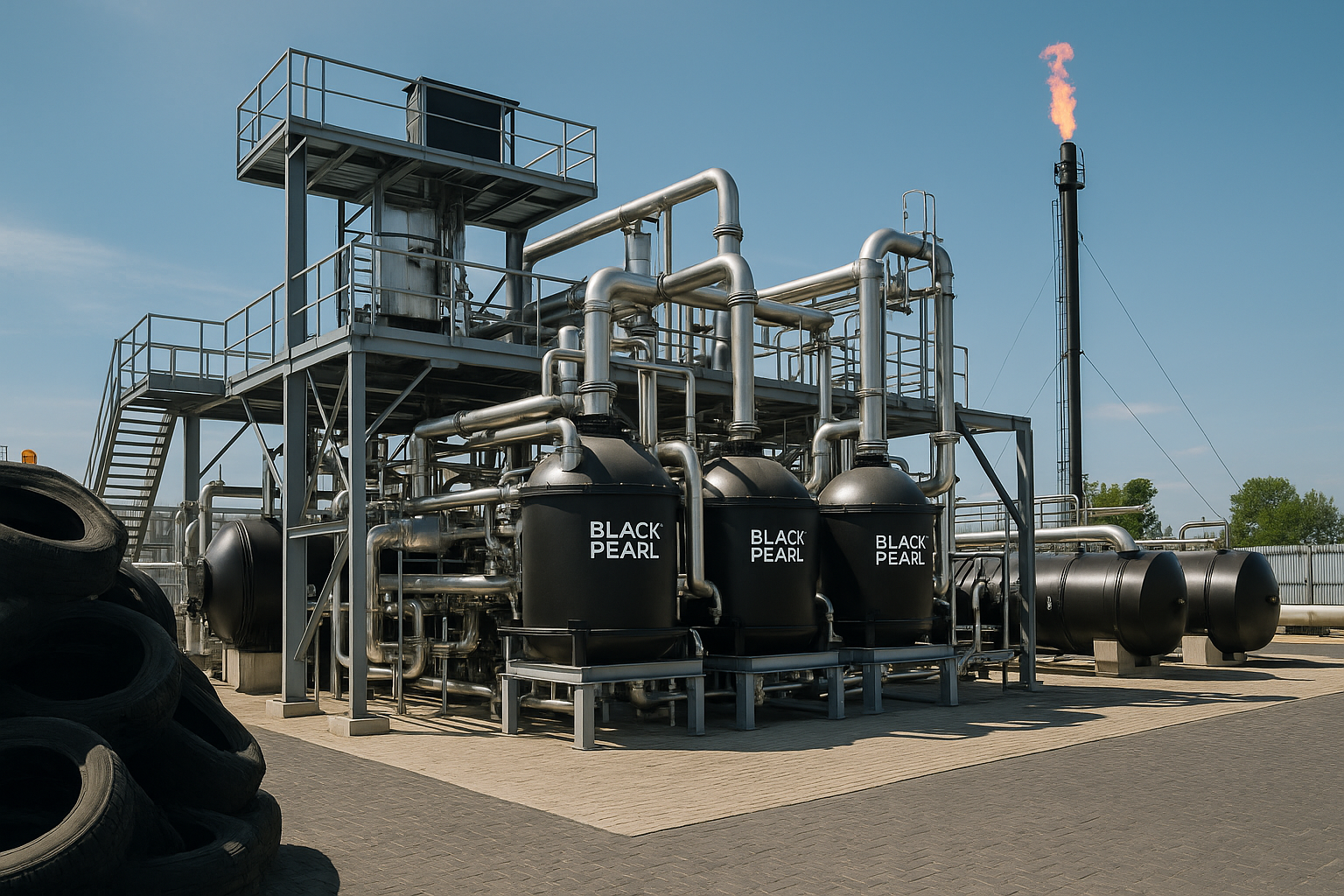
Each Black Pearl plant is built as a modular, fully automated production unit, optimized for continuous 24/7 operation with minimal energy loss and maintenance. The system combines industrial-grade equipment, advanced process control, and zero-emission standards, meeting both environmental and profitability benchmarks.




| BP-Derived Product | Market Size & Growth | Current Supply Gap | Key Drivers | Technology Advantage | Investment Opportunity |
|---|---|---|---|---|---|
| Recovered Carbon Black (rCB) | Demand >2.5M tonnes by 2035; $500M+ current market and rising rapidly | Only ~0.8M tonnes produced — <30% of near-term demand | OEM adoption (Michelin, Bridgestone, Continental), CO₂ reduction mandates, ASTM D8178 standardization | Continuous pyrolysis + corrective additives deliver consistent, in-rubber performance (up to 100% vCB substitution) | High-margin materials gap in a $20B+ carbon black industry; rCB positioned as the sustainable replacement |
| Tire Pyrolysis Oil (TPO) | Market to exceed 30M tonnes by 2035; $71.7B(2023) → $130B (2031) | ~2M tonnes supply — <20% of demand | Circular-fuel adoption, LCFS credits, EU/US recycling laws, refinery offtakes | High-yield, low-sulfur oil meeting industrial and marine fuel specs | Scale up production to meet global deficit; strong carbon credit and offtake upside |
| Tire-Derived Steel Scrap | ~2M tonnes recovered annually; potential todouble by 2035 | Meets just 0.3–0.6% of global scrap demand | Growth of ELT recycling, low-emission steelmaking, circular mandates | Clean, dense recycled steel ideal for electric arc furnaces | Niche but strategic input for green infrastructure; consistent by-product revenue |
.svg)
.svg)